
There's a ritual most job seekers follow without questioning: download a blank resume template, fill in the sections with what you know, export to PDF, and submit. Repeat until someone calls.
The template looks clean. The formatting is professional. You've done the work. Then the inbox stays quiet.
The blank resume template didn't fail you because of bad design. It failed you because it started from the wrong place — your document, not the job. That single inversion is why the Job-First Approach consistently outperforms template-first workflows, and why candidates who've quietly abandoned blank forms are the ones getting callbacks.
The Problem Starts With Where You Begin
Every blank resume template hands you the same thing: a structured form. A placeholder for your name, a section for work history, a section for skills, a space for education. Fill it in, and you're done.
The problem is that "the content you know" is almost never the content a specific employer is actually asking for.
What a Blank Template Actually Provides
A template gives you formatting — consistent section headings, clean spacing, a defensible visual structure. That's genuinely useful. Poorly formatted resumes break ATS parsing before any human sees your name, and templates solve that narrow problem.
They make your resume look like a resume.
What It Can't Tell You
A blank resume template provides zero guidance on which words belong in those clean sections — which skills to lead with, which bullet points to prioritize, which job title variation the ATS is pattern-matching against, which requirements the hiring manager actually weights most.
That's a content problem, not a formatting problem. And content is what most affects how well your application matches the posting. Templates solved the easy part and left the hard part entirely to you.
Why Blank Resume Templates Fail the ATS Test
Before a human recruiter ever sees your resume, an Applicant Tracking System (ATS) processes it automatically. The ATS parses your document and extracts the text, and recruiters can then search and rank applications against the job description, sometimes alongside employer-configured ATS filter rules. Depending on how the employer has configured the system, a lower-ranked application may be sorted further down the list, so the recruiter may never get to it.
Here's the fundamental problem: a blank resume template — even a perfectly formatted one — cannot tell you which keywords to include for this specific job. So candidates fill in the template with language they already know: titles from their last role, their habitual descriptions of their work, their standard list of tools. That language rarely matches the exact terminology an employer's ATS is scanning for.
The Formatting Trap
Some blank resume templates make the ATS problem worse before it gets better. Multi-column layouts, tables, and sidebar designs that look polished to a human eye destroy ATS-friendly formatting requirements entirely.
Multi-column layouts and graphic-heavy PDF exports are a common cause of parse rate problems, because some systems read columns out of order or skip text inside graphics. The designs that win attention at career fairs can parse poorly in automated resume parsing.
The Keyword Gap No Template Can Fill
Even with clean, single-column formatting, the content problem remains.
Many ATS searches and checkers are closer to pattern matchers than to intelligent readers. If the job description says "cross-functional stakeholder management" and your template-filled bullet reads "collaborated with teams across the company" — a human reader sees two equivalent descriptions. A comparison based on keyword matching sees two different strings, and the template version matches little.
A blank resume template asks you to describe your experience in your own vocabulary. The job description tells you exactly which vocabulary the system is measuring you against. Those two vocabularies are rarely the same.
What Tailoring Changes
A resume that is tailored to each specific posting speaks directly to what the employer asked for, which a one-size-fits-all resume cannot do. A higher keyword match against the job description is a useful signal that you have covered the posting's language, though no tool can predict an outcome.
Meanwhile, the average candidate using a blank template sends the same document — or a lightly edited copy — to dozens of roles and can't explain why the callbacks never come. If you've been doing this, you're not alone: sending the same resume to every job is one of the most costly mistakes in modern job searching.
The math isn't complicated. The fix is counterintuitive.
What the Job-First Approach Actually Means
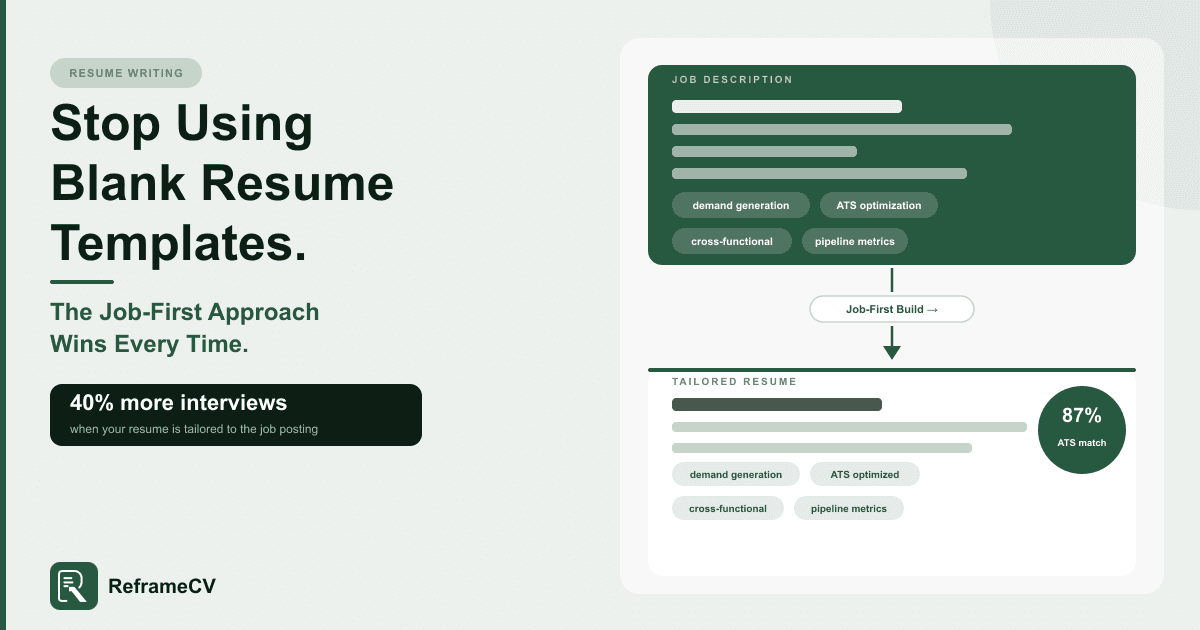
The Job-First Approach inverts the traditional workflow. Instead of starting with your document and hoping the content fits, you start with the job description and let it drive every content decision — which bullets to lead with, which skills to surface, which language to use in your summary, even which job title variation to include.
The Job Description as a Blueprint
Every job description is a specification document. The employer has written down — in their exact language — what they're measuring candidates against:
- Which skills matter most (usually listed first or repeated multiple times)
- Which experience is non-negotiable vs. preferred
- Which terminology the team uses internally
- What success looks like in this specific role
A blank resume template ignores all of this. A Job-First resume is built to mirror it.
What This Looks Like in Practice
A job description for a Senior Marketing Manager might include: "demand generation," "pipeline attribution," and "cross-channel campaign management."
A template-filled resume covering identical work might say: "managed marketing campaigns," "tracked performance metrics," and "worked with the sales team."
To a human reader who already knows the candidate, both convey roughly the same competence. To an ATS performing keyword matching against the job description, the template version matches little. The Job-First version matches much more.
Same experience. Different language. Very different outcomes.
Template-First vs. Job-First: A Comparison
| Template-First | Job-First | |
|---|---|---|
| Starting point | Blank form or downloaded document | The job description |
| Content guidance | Generic — fill in what you know | Specific — mirror what the job requires |
| ATS keyword alignment | Accidental at best | Deliberate and measurable |
| Time to tailor per application | 30–60 min of manual rewriting | Under 10 min when the job drives the structure |
| Output | One document reused across roles | One tailored resume per role |
| Recruiter's quick skim | Generic phrasing, no clear fit signal | Immediate relevance — "this person gets it" |
The gap widens at scale. Using blank resume templates for 20 applications means either 20 hours of manual rewriting or 20 identical submissions. Neither strategy produces consistent callbacks.
How to Switch to a Job-First Workflow
Switching from a template-first workflow to a Job-First workflow doesn't require building your resume from scratch for every application. It's a reordering of decisions — and it works whether you're starting from a blank resume template or a document you've been recycling for months.
1. Read the job description before you open any document. This is the entire premise. The job description tells you what this employer is optimizing for. Read it first, identify the language they use, and note which of your real experiences map to their stated requirements — before you write a single bullet.
2. Extract the 8–12 high-signal phrases. Look for repeated terms, specific tools named explicitly, and the verbs used to describe desired outputs: "own," "scale," "drive," "optimize." These are the target keywords — the exact strings a keyword search is likely to match against. They belong in your resume verbatim, not paraphrased.
3. Map those phrases to your actual experience. You're not fabricating anything. You're selecting which of your real accomplishments best reflects what this employer asked for, and framing it in their language rather than yours. "Managed a cross-functional team" becomes "led cross-functional skills alignment and stakeholder coordination" when the posting uses that exact phrasing.
4. Reorder your experience to lead with what's most relevant. Recruiters often skim a resume quickly on a first read. If the most relevant experience is buried in the third bullet of your second-oldest job, they won't find it. Job-First means the right experience is always visible first — because you structured the document around this role's priorities, not around chronological defaults.
5. Run a quick ATS score check before submitting. Check your resume's keyword match for free against the job description. The walkthrough in how to check if your resume matches a job description explains what the results mean. A low match rate means there are still alignment gaps worth closing. Fix the ones that honestly apply before you hit submit.
This five-step sequence replaces the "fill in the template and hope" workflow with a repeatable system. The time per application drops to under 10 minutes because the job description — not your memory of every past tailoring session — is telling you what to change.
Why Most Resume Builders Are Built Backward
Every major resume builder — Resume.io, Zety, Canva, Kickresume — shares the same foundational assumption: your resume is a document you create once and submit everywhere. Their tools help you build a polished master document. Some add generic phrase suggestions. A few provide ATS-friendly formatting guidance.
But unlike the Job-First workflow, they all start from the blank resume template. The job description, when it features at all, is something you reference after the resume exists — an afterthought, not a driver. AI tools change the content step but not the starting point unless they are job-first; see whether AI can write your resume for the trade-offs.
ReframeCV was built from the opposite direction.
You paste the job description first. The AI analyzes the specific language, requirements, and signals in that posting — and constructs a tailored resume around your actual experience. The output isn't a filled-in template. It's a document built to answer the specific question this employer is asking. See AI resume tailoring for how the feature works.
A blank resume template gives you a canvas. The Job-First approach gives you a blueprint. Canvases produce generic output. Blueprints produce interviews.
The Candidates Getting Callbacks Are Doing This Differently
The job seekers consistently landing interviews aren't necessarily more qualified than you. They've solved a workflow problem that most candidates haven't thought to question.
They don't start from blank resume templates. They start from job descriptions. They apply with fewer applications — each one more precisely aligned with what a specific employer is actually measuring. They spend less time per application because their process is driven by signal, not guesswork.
The competitive advantage isn't working harder. It's removing the mismatch between what a job requires and what your resume communicates — every time, for every role, without spending an hour on it.
If you're ready to stop filling in blank forms and start building resumes that answer the question an employer is actually asking: paste your first job description into ReframeCV and see what a Job-First resume looks like in under two minutes. How credits and free options work is explained on the pricing page.
Not sure where your current resume stands? Check your ATS score for free →